Demography & sexuality
“The Earth can feed 30 billion people if they had to live like the people of Bangladesh, and only 700 million if they all had to live . (The Quid 2001)
This is why . Above all, do not if we do not want to . Since the 1980s, humanity’s exceeds of the biosphere. , with all the dangers that this poses, we must therefore act urgently to minimize environmental degradation.
Only here, this fine reasoning neglects . It is : it to provide for the needs of 7 billion people who have fully gained progress. And even if it were possible , the efforts made would soon be caught up in .
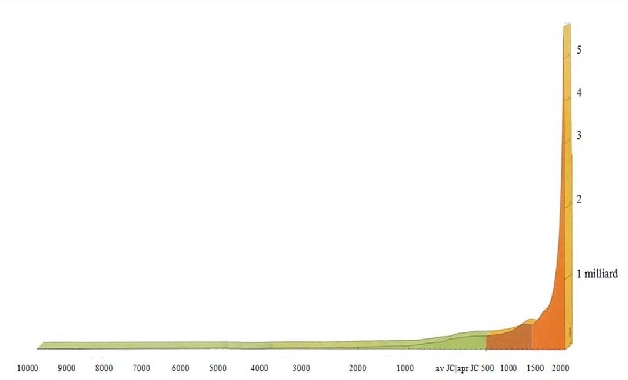
The world population, for a long time, . The goes back from sight in the Middle Ages, and takes an explosive boom at the end of the millennium. Recently, the increase seems rather linear. We were three billion in 60, four billion in 74, five billion in 87, six billion in 99, seven billion in 2012… At the same time, the proportion of individuals with high ecological footprints is growing at high speed. Will it be necessary to wait, in order to put an end to this double lethal evolution, for the to lead us to ? All measures taken in the areas of , , , , [energies-renouvelables], if indeed , they may even encourage procreation and !
Unless it quickly exceeds , the planet will soon be invivable WHAT TO DO. All efforts to preserve the environment will only delay the fateful deadline and, paradoxically, …
According to the demographers, the demographic explosion is the . It is generally mentioned the contributions of medicine, hygiene measures, disease prevention, antibiotics , the reduction of infant mortality, and, a crucial difference with the animal world: [the absence of any predator that takes on the human species](the absence-of-all-predator-who-s-take-the-human-species). Would the man be condemned to …
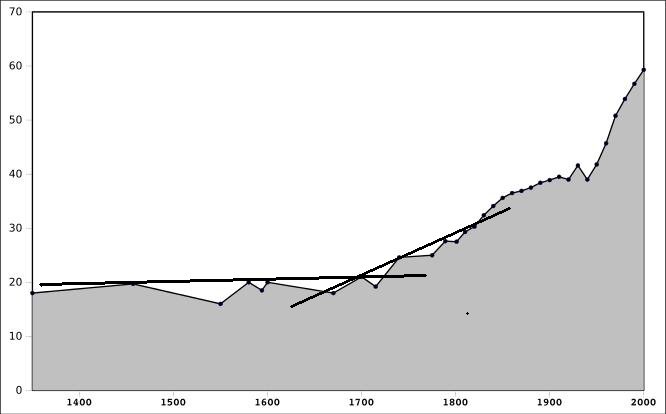
Again, conventional explanations are not necessarily the right ones. The curve of shows an amazing point of inflection at the end of the seventeenth century (the intersection of the two segments on the right).
Medicine has not made any particular progress in this period. Vaccines only started to spread during the 19th century. The sudden change seen as early as 1700 was not explained by or by a decrease in infant mortality (on the contrary, increased by ). It is also not explained by industrial progress, which has far later effects on the population. , no trains ran on the rails, no cars on the roads, food was not plentiful, and the splendors of the court were not for the people.
The only convincing explanation: the French suddenly began to procreate more at the beginning of the Enlightenment century, for obscure reasons. There remains therefore a mystery to explain, . Is it a moral change induced by naturalist philosophies, a physiological cause influencing fertility rate, a psychological factor linked to the genesis of the Revolution…
At present it is . Every year, the planet increases once the population of France. How to slow down the descent to hell? Demographers rely on an alleged “”. It would be enough for poor countries to attain a standard of living equal to ours to see their birth rates decline as in most rich countries. But ! Because the planet would be COMPLETELY DISCOWN long before our standard of living spread everywhere, even under the aegis of gigantic ecological and technological efforts. Faced with danger, under the effect of stress, by need of reassurance, and sink either into catastrophism or irresponsible optimism.
The most elementary arithmetic lets us see a general planetary catastrophe. It is enough to make the figures speak: a planet for 700 million people at the European standing, ten planets for 7 billion, 13 for 9 billion in 25 years, 20 for 14 billion that we would be at the end of the century. It is clear that never the hypothetical reduction of the ecological footprint possible thanks to the new technologies will seriously compensate such explosion.
There will only be room for a fraction of the wealthy, all the others having ended up in undernutrition, lack of fresh water, deprivation, epidemics and inevitable conflicts triggered by a death threat. The dilemma is inevitable: either the big blow to the proliferation of the most predatory species of all time; Or collective suicide…
We’re here. is carried away by currents, the fatal delay approaches at high speed. But the vast majority prefer to keep their habits, believe in progress, increase their standing, close their eyes and reproduce in peace. Let’s open ours a little!
“Try to persuade people to refrain from procreation in the name of morality – great gods! What an outcry! (Leon Tolstoy)
Malthusianism, part of a utopian voluntary reduction of conceptions, was quickly given for a sinister anti-growth doctrine, thus anti-happiness. This is where the best wills are stumbling: it is impossible to obtain from all nations . Unable for non-totalitarian governments to . The problem remains unresolved, whatever the warnings issued by such tops as , and many others.
** Population growth will not be controlled until all mechanisms are understood. **
First of all, it is surprising that the average fertility rate is just above what is required for the renewal of generations. The global average was 2.47 children per woman in 2012. It remains below 2.7 in two out of three countries. It stabilizes in France around 2.01. The . . Invoking a deliberate will of individuals is utopian: rare are the spirits fond of ecology enough to limit their offspring to the name of future generations… There are clearly .
A range of psychological factors can occur. Neglectively: fear of pregnancy, childbirth, end of months, work, care, responsibility for the upbringing of a child. Positively: the image of manhood and its reproductive power, of femininity and the fertile mother, of the family haven of happiness, the need to fill a certain existential void by being in her children, the still underlying influence of the biblical “grow up and multiply”, the perception of a large offspring as a sign of wealth or power, the fear of the rise in power of other nations or religions, or any foolishly family allowances.
All these sociocultural contingencies must be tested as to their impact on birth rates and, the number one objective of human ecogenetics: their origin and their raison d’être.
But one must not forget a primary factor, hitherto neglected by demographers: the way of living sexuality. Yet it is the key element par excellence of fertility!
are an integral part of human nature. They are among the most deeply rooted, because in direct connection with the instinct of reproduction, the primary instinct on which the survival of the species depends. Although innate, they are conditioned by culture, morals, patterns of behaviour, stress and other factors that are still obscure. Their ways of expression have immediate consequences on the probability of fertilization. The image of sexuality that culture conveys influences the types of relationships.
Even if couples try to limit their progeny, . The rate of involuntary fertilization depends directly on the types of relationships and the prevalence of sexual impulses. Only one out of five or ten unwanted children can move from demographic stability to exponential growth.
In any event, there is nothing to exclude a priori unknown links between sexual habits and birth rates. The mysteries of the Eros are far from clear. Many myths, Orphic cults, Tanrism, the Garden of Delights by Jerome Bosch are there to remind us. Our way of living love and sex could be subject, without our knowledge, to that could overly multiply the number of fruitful relationships.
Many more complex and far-reaching issues to be included in the human ecogenetics program…
**The results of the various discussions on the topics discussed on this page will be presented in the comments to the highlighted words, which you can make appear by clicking on them. If you have any relevant objections or arguments, do not hesitate to send them to us by email! **